
Introduction
After much delay, the deadline misses, and numerous setbacks, Elon Musk’s promise to deploy a robotaxi service finally became reality. A special-purpose two-seater vehicle known as the Cybercab operates within a geofenced area of Austin, Texas, employing FSD v13 (full self-driving software).
The launch is a decade-long culmination of Tesla’s efforts to produce autonomous vehicles since Elon Musk promised level 5 autonomy vehicles already by 2018. The launch does not mark a breakthrough in the implementation of full autonomy in the uncontrolled real-world environment – it is a supervised autonomy deployment in a geofenced area, remotely monitored by humans, and requiring human intervention under specific circumstances. Yet, it is real, commercial, and operational.
This article analyzes the current state of the Tesla’s autonomous robotaxi service based on interviews with early passengers, safety reports released by Tesla, and direct comparisons between Tesla and the most advanced existing solution, Waymo One of San Francisco.
How the Service Works
The passenger calls a Cybercab via a dedicated application and waits until the autonomous vehicle arrives. After entering the car via the phone and unlocking it, passengers are driven to their destinations by the vehicle’s AI system.
The current operating zone covers 47 square miles of the city, including the downtown, medical facilities, and University of Texas campus. Tesla’s remote operations center monitors the progress of each trip and allows for the manual overriding of cameras or stopping the vehicle. At present, remote operations team is responsible for approximately 20 Cybercabs at a time, while in the case of Waymo’s early trials, the number of cars per each remote operator was 1:1. This is made possible due to much lower disengagement rates (cases where the operator intervenes).
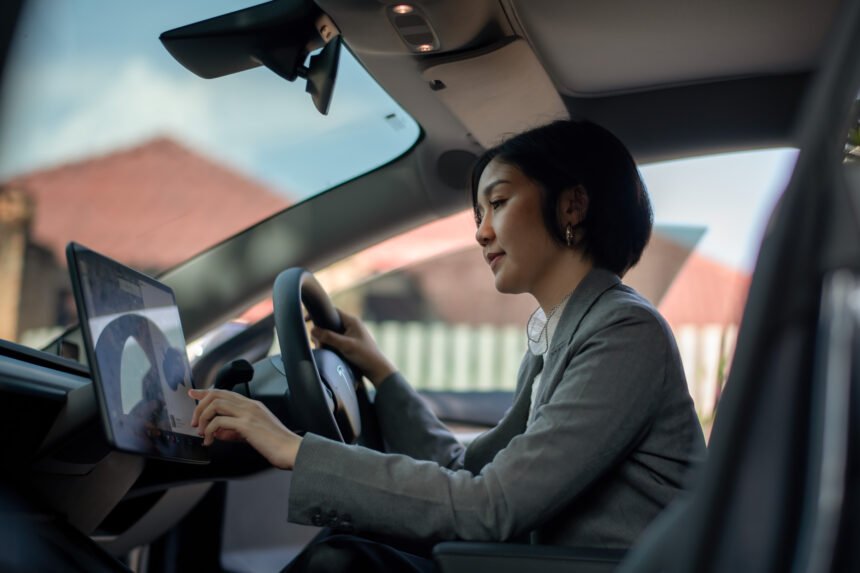
Cybercab is specially manufactured for autonomous driving and cannot operate manually. Hence, its interior differs greatly from the modified conventional production vehicles employed in the current fleet of Tesla robotaxi. In particular, the vehicle’s design includes two forward-facing seats, 17-inch touch screens, and ambient lights, creating a much superior interior environment compared to converted production vehicles. Entry to the Cybercab is done via the application showing a unique passcode.
Storage space of the Cybercab is not very big, allowing only for storing a few objects in the front trunk compartment. The vehicle is not recommended for transporting passengers in need of bringing luggage with them.
Safety Record & Regulatory Oversight
According to the company, within 30 days of launching the service in Austin, more than 12,000 trips were performed safely with zero incidents. There were three disengagements, all caused by unusual objects on the road. This performance is comparable with Waymo’s performance in the earlier period of launching autonomous services, although San Francisco road conditions are more difficult than those of Austin.
However, the comparison with Waymo shows some differences that are relevant to the safety performance of the Cybercab. Namely, the road conditions in San Francisco are more complex than those of Austin. Besides, San Francisco includes a greater amount of traffic and obstacles like cable cars and bicycles traveling against the traffic flow, whereas such traffic elements are absent in Austin.
Moreover, the road geometry in Austin makes intersections much easier to recognize and navigate. This may suggest that the performance statistics obtained by Tesla should not be extrapolated into more complicated urban settings.
NHTSA monitors the deployment closely. According to US legislation, autonomous vehicles are subjected to the same regulatory regime as ordinary cars. However, Texas regulations regarding autonomous vehicles are more liberal than California regulations that forced Waymo to conduct years of experiments before deploying the autonomous fleet. Thus, in Texas, Tesla could start operations immediately after passing the local safety checks.
To ensure proper safety performance of the robotaxis, NHTSA requests that any accidents or incidents related to Tesla’s autonomous fleet be immediately reported by the manufacturer to the agency’s database and assess whether additional regulatory oversight mechanisms should be put in place as the fleet grows. NTSB is also independently conducting an investigation of the Tesla’s robotaxi service.
How It Compares to Waymo
Comparisons with other companies can show how good or bad Tesla’s robotaxi is. In the context of the article, it is useful to draw the contrasts between Waymo One of San Francisco and Tesla robotaxi service.
For example, Waymo One uses a combined approach to autonomous driving, including LiDAR, radar, and visual cameras. On the contrary, Tesla’s strategy relies purely on visual data and artificial intelligence, and the company actively refuses to use LiDAR systems. Thus, we see two different technologies applied to the problem of autonomous vehicles.
The results of Waymo One are impressive: the vehicle traveled millions of kilometers in the challenging city environment under various environmental conditions (e.g., night-time driving), experiencing few accidents. Tesla’s robotaxi is also functioning well. However, it was launched much faster than the Waymo’s version, and this is the consequence of the cheaper technical platform chosen.
As for passenger experience, the interior of Cybercab looks much better than the interior of Waymo’s modified cars. Nevertheless, both Tesla and Waymo use apps to request an autonomous vehicle.
Overall, it can be said that the main difference is a philosophical attitude toward implementing autonomy in vehicles. Tesla’s approach faces a more difficult task but manages to solve it. Conversely, Waymo chose a relatively easy technical challenge but had to invest significantly in hardware. It is unclear yet which approach will yield better results.
Conclusion
Thus, we have discussed Tesla’s real-life robotaxi and how it compares with the alternative approaches to autonomous cars. Although this launch does not signal the dawn of widespread autonomous vehicles, it is definitely a great step towards a bright future of mobility.
The key question raised by the launch is: does the technology work in the real world in all environments? While Tesla’s autonomous robotaxi performs admirably in Austin right now, only the time will tell whether this technology will become widely popular across the country.