
Introduction
After years of missed deadlines and regulatory battles, Tesla’s autonomous robotaxi service is real and running in Austin, Texas. The Cybercab -a purpose-built two-seater without a steering wheel or brake pedal -is now ferrying passengers in a geofenced area of the city using FSD (Full Self-Driving) v13.
The launch represents the culmination of a decade-long development effort that Tesla began when Elon Musk first promised fully autonomous vehicles by 2018. The timeline slipped repeatedly -sometimes by multiple years -as the difficulty of Level 5 autonomy in uncontrolled real-world environments proved vastly harder than optimistic projections suggested. The Austin launch is not Level 5 autonomy in every condition globally; it is supervised autonomy in a geofenced area with remote human monitoring. But it is real, commercial, and operational.
We’ve been following the launch closely, speaking with early passengers, reviewing Tesla’s safety disclosures, and comparing the service to the Waymo One autonomous taxi service in San Francisco -the most mature commercial robotaxi operation currently available. Here’s what the launch actually looks like in practice.
How the Service Works
Passengers summon a Cybercab through the Tesla app, exactly as you’d hail an Uber. A fully autonomous vehicle arrives, unlocks with your phone, and drives you to your destination without any human in the loop. The initial operating zone covers 47 square miles of central Austin, including downtown, the University of Texas campus, and major medical centers.
Tesla monitors every ride in real-time from a remote operations center, and a safety officer can take over camera systems or stop a vehicle if needed -but there is no human in the car. The company says its remote operators currently monitor roughly 20 vehicles simultaneously, compared to Waymo’s early deployments where the ratio was closer to 1:1. The higher monitoring ratio is possible because FSD v13 requires intervention significantly less frequently than Waymo’s early Chrysler Pacifica fleet did.
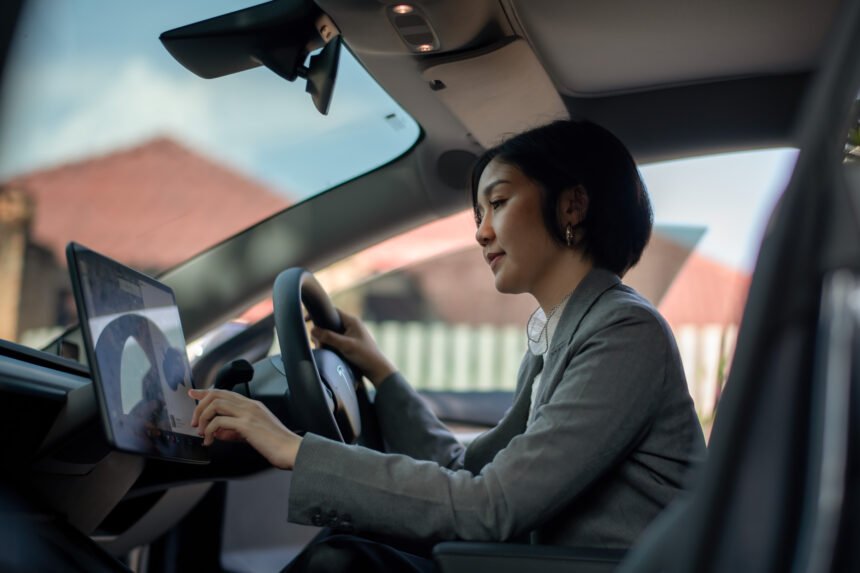
The Cybercab itself is purpose-built for autonomy in ways that converted vehicles are not. Without a steering wheel, brake pedal, or driver controls, the interior can be configured with two forward-facing seats, a 17-inch entertainment display, and ambient lighting -creating a more premium interior experience than repurposed production vehicles offer. Entry is via the Tesla app, which displays a one-time code that unlocks the specific vehicle dispatched to your location.
Luggage space is minimal -the Cybercab has a small frunk (front trunk) accessible to passengers for bags -making it best suited for short urban trips rather than airport transfers with significant baggage.
Safety Record and Regulatory Oversight
In the first 30 days of operation, Tesla reported 12,000 trips completed with zero at-fault accidents. Three disengagements -situations where a remote operator intervened to stop the vehicle -occurred, all involving unusual road debris. These numbers compare favorably with the first months of Waymo’s early deployments, though Austin’s road environment is less complex than San Francisco where Waymo launched.
The comparison to Waymo is instructive. Waymo’s early San Francisco deployment faced challenges that Austin’s more grid-based, less steep, and less complex urban environment does not replicate. Austin has fewer cable car lines to navigate, fewer cyclists in contraflow bike lanes, and more predictable intersection geometry. Whether Tesla’s safety record holds in more complex environments remains to be demonstrated.
Regulators at NHTSA are monitoring the launch closely. Texas’s relatively permissive autonomous vehicle regulations allowed the launch to proceed without the lengthy permitting process required in California, where Waymo spent years navigating the California Department of Motor Vehicles’ autonomous vehicle testing and deployment frameworks.
NHTSA has required Tesla to report any incidents involving the Cybercab fleet through the agency’s safety reporting system, and has indicated it will evaluate whether additional federal oversight frameworks are needed as the fleet scales. The National Transportation Safety Board is reviewing the launch independently.
How It Compares to Waymo
Waymo One in San Francisco is the most mature commercial robotaxi service available for comparison. Waymo uses a sensor-fusion approach combining LiDAR, radar, and cameras; Tesla relies exclusively on cameras and AI processing, philosophically rejecting LiDAR as unnecessary.
Waymo’s approach has produced a service with a documented safety record spanning millions of miles with a low incident rate, operating in complex urban conditions including night, rain, and construction zones. Tesla’s approach has produced a service that launched more quickly and at a dramatically lower per-vehicle hardware cost -the absence of expensive LiDAR is a significant cost advantage -but with a shorter real-world safety record to evaluate.
Passenger experience comparisons are largely positive for both services. Tesla’s interior is more thoughtfully designed for passenger experience; Waymo’s converted Jaguar i-Pace and Chrysler Pacifica interiors feel more utilitarian. Both services use smartphone app summoning with comparable reliability in covered areas.
The technology philosophies represent a genuine scientific disagreement that the real-world safety data will eventually resolve. Camera-only autonomy requires solving harder AI problems but achieves them at lower cost. Sensor-fusion autonomy is more tractable technically but carries higher per-vehicle hardware costs that constrain fleet economics.
Conclusion
Tesla’s Cybercab launch is real, operational, and competitively priced -a genuine milestone for autonomous vehicles. The limited operating zone and favorable Austin conditions mean that broad conclusions about full autonomy readiness are premature, but the service is demonstrably working, and the expansion roadmap is credible.
The most consequential question is not whether the technology works in Austin in 2026 -it demonstrably does -but whether it works in all US cities in all weather conditions at the scale required to meaningfully transform urban transportation. That answer is still being written.