
Introduction
Look at the top corner of your smartphone right now. You will likely see one of two symbols: a glowing Wi-Fi icon or a bold “5G” badge. For years, we were told that connecting to a home Wi-Fi network was the absolute best way to guarantee fast, stable internet. But as we navigate through 2026, the lines between cellular data and home broadband have blurred completely.
Today, 5G networks have matured, blanketing cities with gigabit speeds that rival traditional fiber-optic cables. Simultaneously, home networking has undergone a revolution with the widespread adoption of Wi-Fi 6E, unlocking an entirely new spectrum of wireless bandwidth.
When you are downloading a massive 4K movie, playing a competitive mobile shooter, or uploading gigabytes of RAW photos to the cloud, which connection should you actually be using? In this comprehensive guide, we break down the real-world speeds, latency, and battery consumption of 5G and Wi-Fi 6E to crown the ultimate connectivity champion of 2026.
Understanding the Contenders
Before we pit them against each other in a speed test, it is crucial to understand how these two technologies deliver data to your smartphone, because they operate on completely different principles.
What is 5G in 2026?
5G is the fifth generation of cellular network technology. By 2026, the global 5G rollout has largely stabilized, meaning we are finally experiencing the speeds telecom companies promised years ago. However, not all 5G is created equal. Your smartphone connects to one of two main types of 5G:
- Sub-6GHz 5G: This is the most common type. It travels incredibly far and easily penetrates buildings. It offers speeds significantly faster than 4G LTE, but it is not mind-blowing (usually hovering between 100 Mbps to 400 Mbps).
- mmWave (Millimeter Wave) 5G: This is the hyper-fast, gigabit-speed 5G. It operates on extremely high frequencies, allowing for massive data transfer. The catch? It has a terrible range and can be blocked by a single tree, a window, or even your hand. You will mostly find mmWave in dense downtown areas, stadiums, and airports.
What is Wi-Fi 6E?
For over two decades, Wi-Fi operated on just two crowded radio bands: 2.4GHz and 5GHz. Think of these as two-lane highways that are constantly jammed with traffic from your neighbour’s routers, baby monitors, and smart TVs.
Wi-Fi 6E changed the game by opening up the 6GHz band. This is the equivalent of building a brand-new, massive, eight-lane superhighway reserved exclusively for the newest, fastest vehicles (devices). Because older devices cannot access the 6GHz band, a Wi-Fi 6E connection on a modern smartphone experiences zero interference, zero congestion, and allows for gigabit speeds to flow freely through your home.
Head-to-Head: Which is Actually Faster?
If we look purely at theoretical numbers on a spec sheet, both technologies are staggering. Wi-Fi 6E can theoretically hit speeds of 9.6 Gbps, while mmWave 5G can hit upwards of 10 Gbps. But theoretical speeds do not exist in the real world. Here is what actually happens when you hit “Download” on your smartphone.
The Real-World Speed Test
In everyday scenarios, Wi-Fi 6E is generally faster and significantly more consistent than 5G. If you have a gigabit fiber-optic internet connection coming into your house and a high-end Wi-Fi 6E router, your smartphone can easily pull down 800 Mbps to 1.2 Gbps consistently, in almost every room of your house.
5G, on the other hand, is highly volatile. If you are standing directly under an mmWave 5G node in a major city center, your phone might hit an astonishing 2.5 Gbps-absolutely destroying Wi-Fi speeds. However, the moment you walk around a corner, step inside a coffee shop, or drive half a mile down the road, your phone switches back to Sub-6GHz 5G, and your speeds plummet to around 200 Mbps.
The Verdict on Speed: Wi-Fi 6E wins for consistency and everyday reliability. 5G wins only if you are in the perfect location with a flawless mmWave signal.
Latency and Ping: The Gamer’s Dilemma
Speed is only half of the connectivity equation. If you play competitive mobile games like PUBG Mobile, Call of Duty: Warzone, or League of Legends: Wild Rift, you don’t care about massive download bandwidth-you care about latency.
Latency (measured in milliseconds or “ping”) is the time it takes for a signal to travel from your phone to the server and back. If your latency is high, your game lags, and you lose.
- 5G Latency: While 5G was heavily marketed as having “ultra-low latency,” real-world cellular networks still have to route your signal through cell towers, local hubs, and massive geographic distances. An excellent 5G connection usually yields a ping of 25ms to 40ms.
- Wi-Fi 6E Latency: Because the 6GHz band is completely free of interference and your phone is communicating with a router sitting just feet away, Wi-Fi 6E latency is virtually non-existent on the local network. Assuming you have good home fiber internet, your gaming ping will frequently sit between 5ms and 15ms.
The Verdict on Latency: Wi-Fi 6E is the undisputed champion. Hardcore mobile gamers should always play on a high-quality 6GHz Wi-Fi network to eliminate lag spikes and packet loss.

Battery Life: The Hidden Cost of Speed
One of the least discussed aspects of the 5G vs Wi-Fi debate is how these connections affect your smartphone’s battery life. Pushing massive amounts of data through the air requires energy, but the two technologies draw power very differently.
The 5G Battery Drain
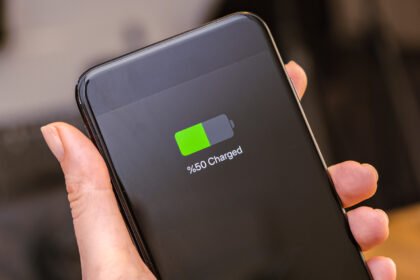
Connecting to a 5G network is incredibly taxing on your phone’s modem. Your smartphone constantly has to shout its signal across miles of open air to reach the nearest cell tower. Furthermore, as you walk or drive, your phone is aggressively scanning the horizon, switching between different towers and alternating between Sub-6 and mmWave bands to maintain the connection. This constant background activity generates heat and heavily drains your battery.
Conclusion
The battle between 5G and Wi-Fi 6E isn’t really a competition-it is a partnership. They are two sides of the same technological coin in 2026.
If you are looking for the absolute fastest, most stable, and battery-friendly connection for your smartphone, a home Wi-Fi 6E network backed by fiber internet is currently unbeatable. However, the sheer convenience, expanding gigabit speeds, and ironclad security of 5G make it the undisputed king the second you walk out your front door. By understanding the strengths of both, you can ensure your smartphone is always operating at peak performance.