
Introduction
At WWDC this year, Apple took another big leap towards realizing its spatial computing ambitions by announcing Vision Pro 2, the follow-up to the original model which addressed the two most significant issues with the original device: price and weight. The new model comes in a substantially lower price ($2,999 compared to the original $3,499) and cuts off 200 grams from the original Vision Pro, housing the most advanced chip Apple created for any of its products to date.
Apple’s Vision Pro was one incredible feat of engineering, albeit one not really meant to be a mass consumer device from its initial release – rather, it was meant to demonstrate the capabilities of the device, act as a platform for development and showcase its possibilities before Apple worked on bringing the technology to more people. Vision Pro 2 looks like a step in that direction.
Design and Comfortability
The original Vision Pro’s 600-grams weight became a source of criticism among many reviewers and early adopters of the device, but Apple decided to address it by redesigning the entire headset frame, using aerospace-grade magnesium alloys in the new build, and redistributing the battery. In particular, it now becomes part of the headset frame, which eliminates the need for the previous bulky cable that used to connect the headset to an external battery unit.
To cut down the weight by approximately 200 grams, Apple relied on three design choices: using magnesium alloys which allow building a headset of the same rigidity as the original Vision Pro but are 30% lighter; integrating the battery into the frame which means removing all cables altogether as well as the necessity of storing the external battery in your pocket; and using lightweight lenses for the optics assembly.
In addition to this, Vision Pro 2 gets a new, wider Solo Knit Band and an additional size. The new padded band design features two layers, a moisture-wicking inner layer and a memory foam outer layer which evenly distribute the clamping force on the forehead and temples, solving one of the main complaints Vision Pro owners voiced in the early days – uncomfortable areas where the original headset used to put pressure. Moreover, Apple expanded its third-party prescription lenses compatibility program which now includes a range of brands.
M4 Ultra Chip and Performance
Vision Pro 2 relies on M4 Ultra chip, the most recent iteration of the M chip line, which powers the newest Mac Pro. With 32 GPU cores, the M4 Ultra is more than capable of handling full 8K resolution per eye and 120 Hz refresh rate. Apple reports a 40% graphics performance increase over the M2 chip from the original Vision Pro.
Speaking of performance, one of the aspects of spatial computing is the necessity to process a huge amount of data related to environment and face recognition, tracking the movement of hands and eyes with millisecond precision and rendering virtual objects. In this respect, the neural engine of the M4 Ultra chip proves particularly valuable – Apple claims a 40-core NE which processes machine learning inference tasks extremely fast.
Furthermore, the new version of Vision Pro 2 got a new iteration of R2 co-processor which, according to Apple, can perform sensor fusion and pass-through camera tasks with virtually imperceptible latency. While the original device’s 12 ms pass-through latency was impressive and undetectable to an average user in most cases, the fact remained that fast movement would reveal it to the user. The newer R2 is said to provide less than 6 ms pass-through latency, placing it into the category where human vision cannot differentiate a digitally processed view of the environment from the optical one.
New Features and visionOS 3
With Vision Pro 2, Apple released a new version of its spatial computing operating system – visionOS 3. Its main new feature is the introduction of Spatial Personas – lifelike 3D representations of yourself which appear in FaceTime and collaborative applications featuring facial animation that is far superior to the one in the original model. The latter’s Persona feature suffered criticism for producing an effect similar to uncanny valley due to inconsistent light and textures. New visionOS 3 Spatial Personas utilize the additional power of M4 Ultra NE and rely on a far more advanced facial mapping algorithm.
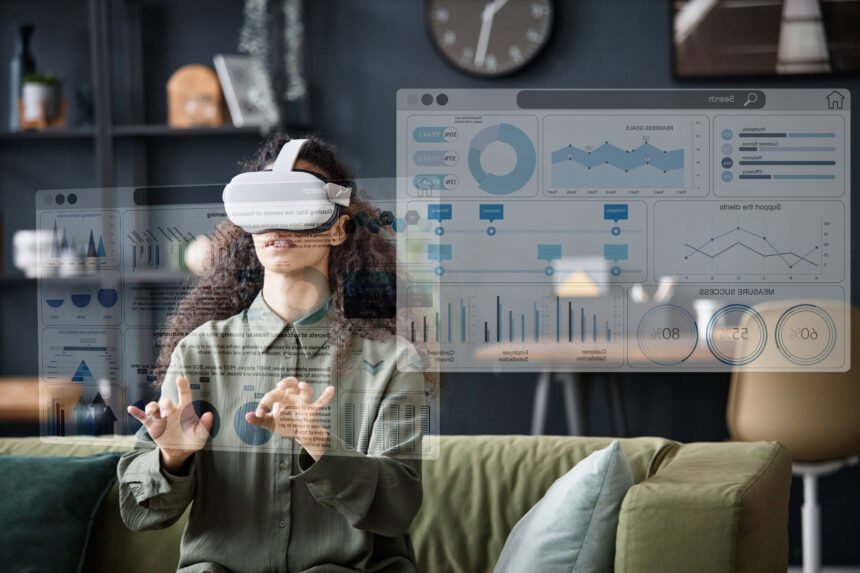
The visionOS 3 Spatial Canvas application is designed to allow several Vision Pro users to collaborate on a single real-time 3D design project, allowing them to simultaneously manipulate, annotate and present designs. This kind of collaboration becomes possible because of spatial computing and is far superior to regular screen-sharing.
Apple also announced its first attempt at developing native games for spatial computing platforms, including multiplayer titles where up to 16 players can anchor virtual game elements to the actual space, meaning that everyone involved would see the same objects, regardless of location. Such a persistent, shared spatial gaming experience was unheard of previously and was unique to visionOS.
At present, the App Store for visionOS contains over 2,400 apps – a sufficient number for the platform to become a tool of choice not just for fun but also for working with spatial computing software, including Microsoft Office and Adobe Creative Suite.
Price, Availability, and Vision Pro Lite
The Vision Pro 2 starts at $2,999 – $500 less than the original. Apart from regular Vision Pro, Apple now introduces a Lite configuration which comes at the price of $1,999 but lacks the hand tracking cameras and some components of the spatial sound system. Vision Pro Lite, therefore, targets primarily those interested in spatial computing for productivity purposes rather than gaming.
Vision Pro 2 and Vision Pro Lite will go on sale in the United States, UK, Europe, Canada, and Australia simultaneously, and in 90 days, Apple expects to release the product in additional regions. The company also plans to host demo sessions in its stores on the first day of presales. Since spatial computing is something that requires experiencing physically to assess its true value, this step is essential for Apple’s marketing strategy.
Another interesting novelty this year is educational pricing tier for Vision Pro – Apple announced 10% discounts for educational buyers for the first time in this line of devices. Medical, architectural, and design programs in universities are expected to become some of the early adopters.
Lastly, users of the previous Vision Pro generation are welcome to trade in their products with maximum credit value of $800 to purchase Vision Pro 2.
Conclusion
Vision Pro 2 addresses all valid criticisms of its predecessor, reducing the weight, cost, and making it more wearable and comfortable for daily usage. It is still not a mass market consumer item at $2,999 but at least the new Lite tier shows its intention to drive spatial computing into mass market in two product cycles.
For those who were among the early adopters of Vision Pro 2 and enjoyed using it, the upgrade will be noticeable from all perspectives – comfort, performance, availability of the content, and improved social presence provided by visionOS 3. For those who were interested but hesitant, this could very well be their chance to evaluate the platform.